Postage Stamp
83rd Deutscher Katholikentag Trier
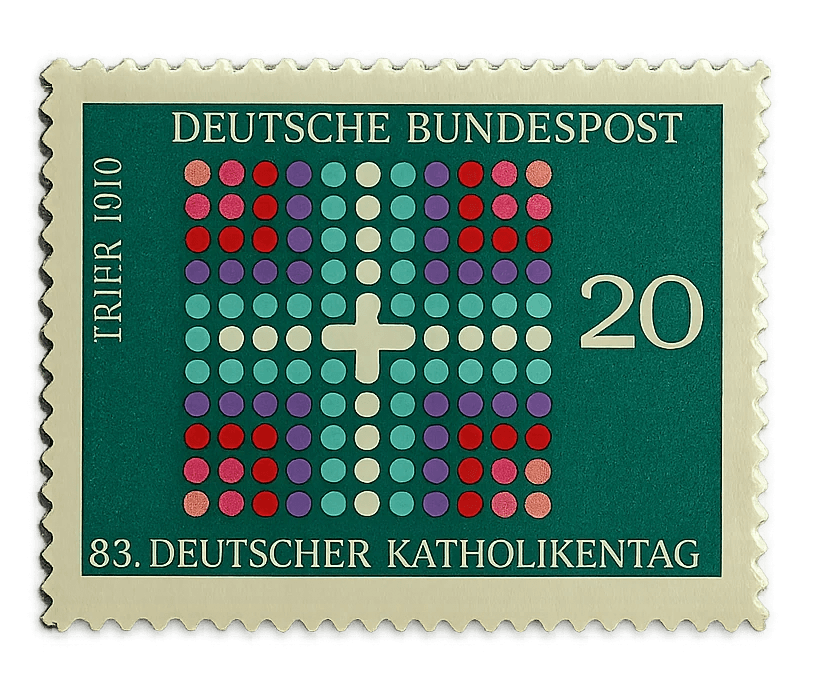
A vibrant 1970 West German postage stamp featuring a geometric grid of multi-colored dots forming a cross, set against a deep forest-green background.
About
The Deutscher Katholikentag is a large gathering of German Catholics held every two years, moving between cities. The 83rd edition took place in Trier in 1970 — one of Germany's oldest cities, and a significant one for the Church: it holds the Heilig Rock, the relic claimed to be the seamless robe of Christ, and its cathedral is among the oldest in the country.
West Germany marked the occasion with this stamp, and the designer made a choice that must have felt like a risk: no cathedral, no cross in any traditional sense, no religious iconography in the familiar way. Instead, a grid of multicolored dots — red, yellow, blue, orange, white — arranged so that the form of a cross emerges from the pattern against a deep forest-green background. Symbol through structure. Religion rendered as geometry.
It's a very 1970 solution, and it works completely.
What I Find Inspiring About This
The cross only exists because of what surrounds it. Take away the green field and the dots just become a grid — the negative space is doing the symbolic work. That's an unusual inversion: most religious imagery asserts its meaning loudly. This one requires the eye to find it.
What I find genuinely interesting here is the dot grid as a compositional tool. Each dot is a single color, no gradients, no transitions — and yet the overall field reads as vibrant and warm rather than cold or mechanical. The variety of hues across the grid keeps it alive. It's the kind of color strategy where no single color dominates, and the effect comes from the accumulation rather than any individual choice. I think about that logic a lot when working with pattern-based backgrounds in web layouts: the unit can be simple as long as the field has enough variety to breathe.