Book
Bauhaus Taschen book
The Taschen Bauhaus book sitting on a shelf is a reminder that the most influential design school in history lasted just 14 years.
About
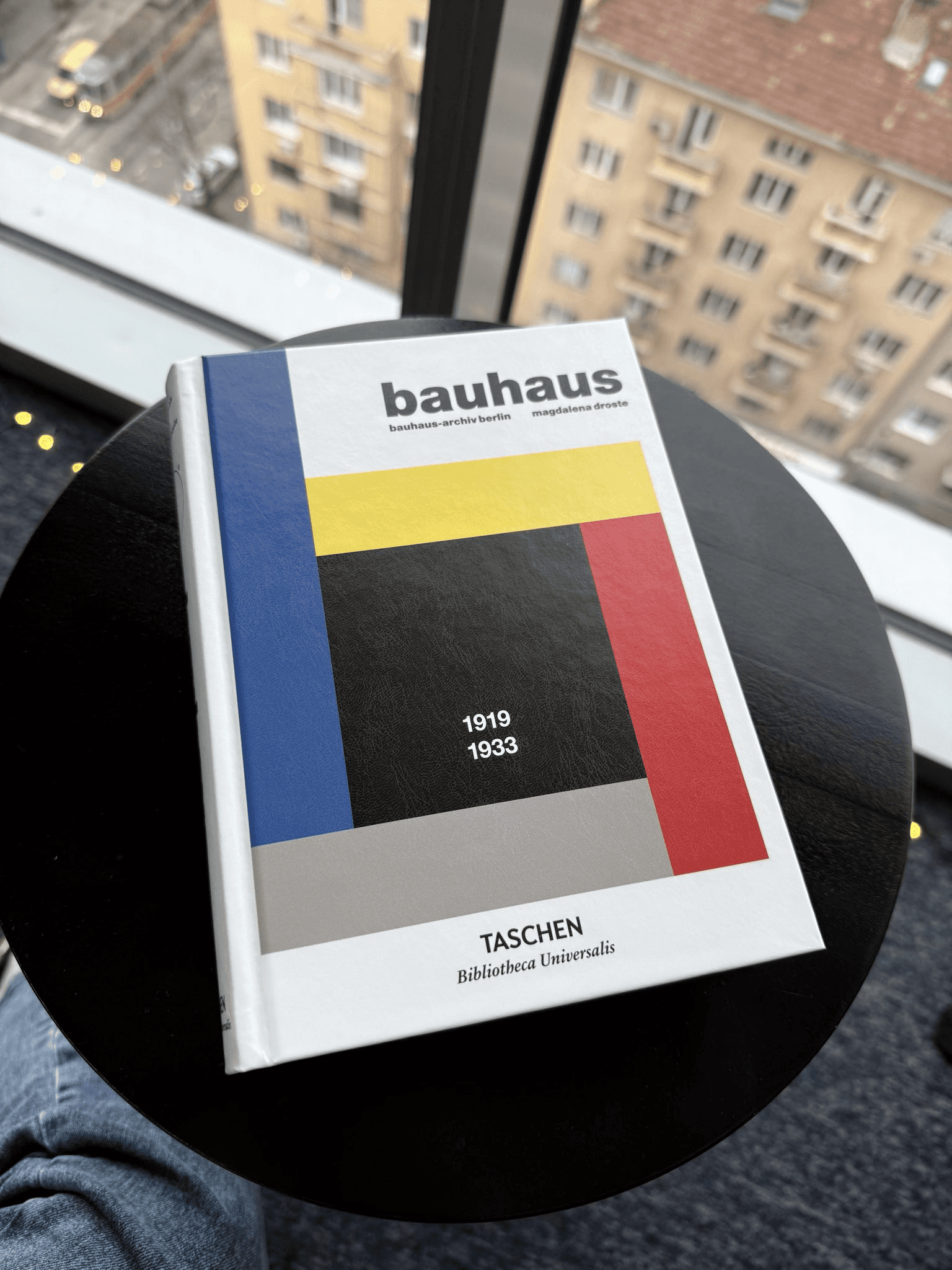
The Taschen Bauhaus hardcover. Red, yellow, blue. The title in clean sans-serif, nothing else competing for attention.
The Bauhaus school ran from 1919 to 1933 — 14 years before being shut down by the Nazi regime. In that time it essentially invented the visual language that modern design still speaks: the grid, functional typography, geometric reduction, the unity of art and craft. This book is Taschen's comprehensive archive of the whole project.
It lives on my shelf less as something I read cover to cover and more as something I keep coming back to in pieces.
What I Find Inspiring About This
There's a specific quality to Bauhaus design that I think gets misunderstood when people call it "minimal." It wasn't minimal for aesthetic reasons — it was minimal because every unnecessary element was considered a failure of thinking.
Form follows function isn't a style. It's a position. The circle, the triangle, the square weren't chosen because they looked clean — they were chosen because they were irreducible. You can't simplify them further. That's a completely different starting point than most contemporary UI design, which tends to strip things back for visual reasons rather than logical ones.
What I keep pulling from it: the idea that restraint has to be earned, not applied. A grid works when the content needs a grid. White space works when the silence means something. Bauhaus designers weren't decorating with emptiness — they were building systems.
That rigour is the thing I try to carry into web design and Framer work. Not the aesthetic, exactly, but the discipline underneath it.